The journal
When a garage door spring breaks: what to do, and what not to
The bang, the gap in the coil, the opener that strains: why the door stays where it is, why the release cord stays alone, and what happens at the visit.
AI-generated illustration. Not a real home or business.
The bang
If someone is trapped or hurt, call 911. This website is not an emergency service.
A torsion spring usually goes with one loud bang, like something heavy dropped in the garage, and often when nobody is anywhere near the door. Afterwards the door looks the same as it did. What changes is what happens the next time anybody asks it to move: the opener strains and the door lifts a little and stops, or does not lift at all, and a door opened by hand is suddenly far heavier than it was.
From the floor, without touching anything, the spring itself usually shows what happened:
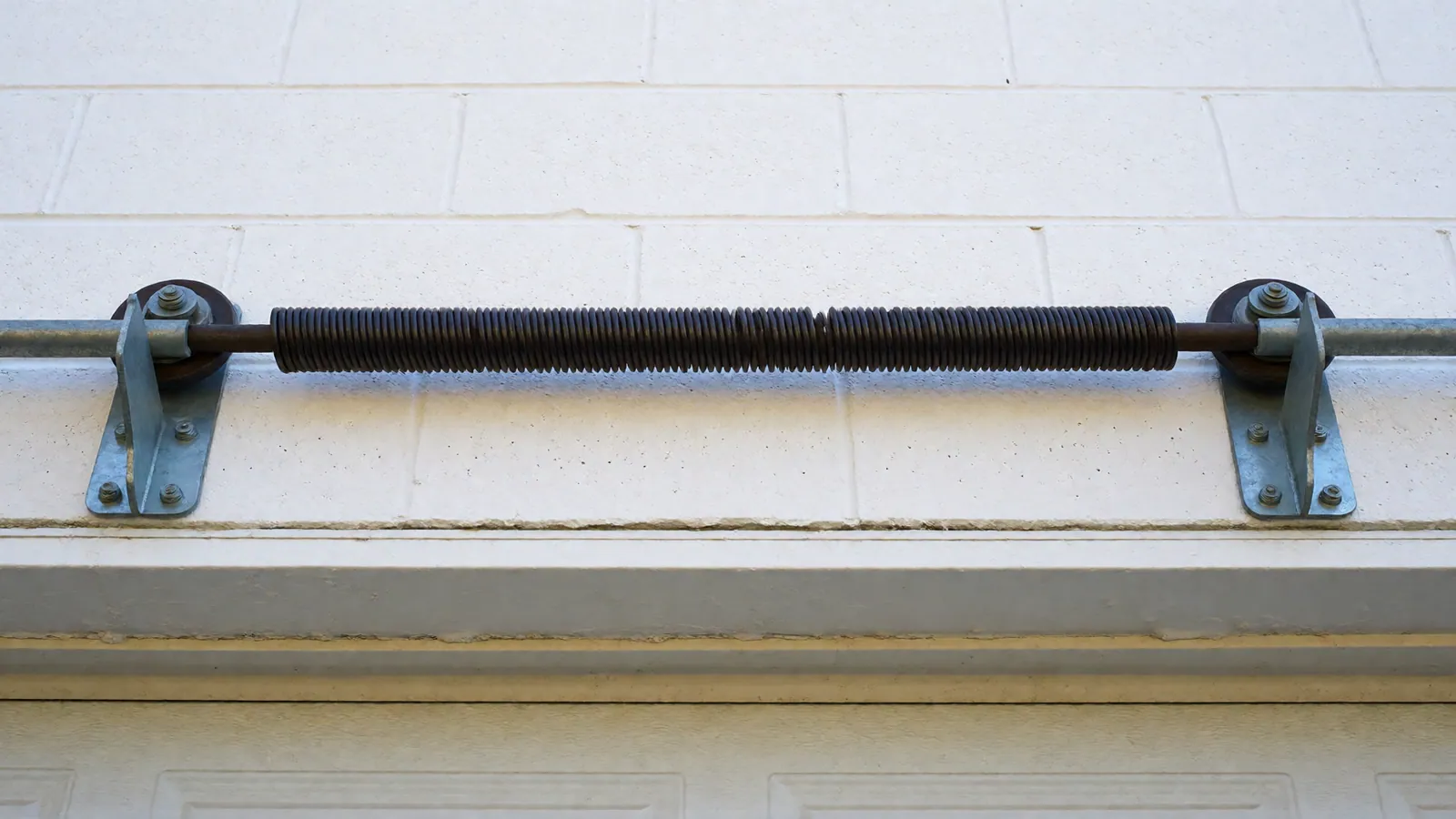
A torsion spring that has broken usually shows a gap of a few inches in its coil. You can look for one from the floor; never climb up to it or touch it.
Leave the door where it is
The springs were carrying the door's weight. With one broken, that weight is held by whatever is left, the other spring, the cables and the opener's hold on the door, and none of them was meant to carry it. Running the opener again, or lifting the door by hand to get the car out, asks those parts to do the spring's job, and when one of them gives, the door comes down. That is why the symptom check's answer is the same whatever else is true:
A worked example: a symptom check
A loud bang, and the opener struggles A one-car door under an attached brick house in Woodside
The twelve answers behind it
- What do you need?
- Something is wrong with the garage door at my house
- Where is the house?
- Woodside or a neighborhood next to it
- Do you own the house?
- Yes, I own it, alone or with someone
- What kind of house is it?
- An attached or semi-detached house, one home
- What kind of garage door is it?
- Sections that roll up overhead on two tracks
- How wide is the door?
- One car wide, about eight to ten feet
- Where are its springs?
- On a bar across the wall just above the door
- Does it have an opener?
- Yes, it opens with a button or a remote
- Are there two small safety sensors near the floor, one on each side of the door?
- Yes, there is a small sensor low down on each side of the door
- Roughly when was the opener put in?
- 1993 or later
- What is the door doing?
- There was a loud bang, and now the door won't lift or the opener struggles
- Where is the door right now?
- Closed, or nearly closed
Use the door?
Stop using the door until it is seen
Stop using the door until it has been looked at. Don't run the opener, don't try to lift the door by hand, and don't pull the opener's red release cord: with a weak or broken spring the door can drop fast. Don't touch the spring, the cables or the brackets at the bottom corners of the door. Keep people, pets and cars out from under it.
The opener's release cord disconnects the door from the opener. On a door with a broken spring it takes away the only thing holding the door up, so it is never pulled on a door that may have one.
Check-first list
What a technician looks at for what you describe, in the order they look. It names no fault: nobody has seen the door.
- The springs Whether either is broken, and whether the door is balanced once the opener is disconnected by the technician.
- The lift cables and drums Both cables, from the drum at the top to the bracket at the bottom corner, for fraying, slack and how they sit in the grooves.
- The tracks Whether both are straight, upright and bolted tight, and the rollers sit in them all the way up.
- The opener's settings Its travel limits and its force setting, and the reversing test on something placed under the door.
- The opener's reversing test, as New York requires Run by anyone who works on a garage door, its springs or its tracks. If the opener fails it, a DANGER label goes on the opener and you get written notice within ten days.
What you can check yourself first
Nothing: leave it for the technician.
Price range at our published prices
- The first visit costs nothing, and you don't have to sign anything after it.
- Both torsion springs replaced$290 to $360
- Both lift cables replaced$175
- The price range, before tax$175.00 to $535.00
- Sales tax, 8.875%$15.53 to $47.48
- The price range, with tax$190.53 to $582.48
From the least it could need to everything listed. A written price is given at the first visit, and the repair is done after the three business days to cancel.
- New York lets work start at once only in a genuine emergency, such as a door stuck open that leaves the house unsecured, and only if you called the company yourself and you write out, by hand, a dated and signed statement describing the emergency and saying you give up your three days to cancel. Nobody should hand you a printed one, and it covers only the emergency repair, not anything else offered on the same visit. This website can't take that statement and never asks for it.
The symptom check's answer to these questions, at the published prices. Nobody has seen your door.
The card stops the door before it lists anything, and offers nothing to try first. Its list starts with the springs and then the cables, because those are what a bang points at, and its price range runs from the least the door could need to the springs and the cables together, because a door can need both at once.
Why the release cord is left alone
Every opener has a cord with a handle hanging from its rail, there to disconnect the door from the opener so that it can be moved by hand when the power is out. On an ordinary day it is a convenience. On a door with a broken spring it is the one thing that should not be touched, and the card above gives the reason in a sentence: the opener may be all that is holding the door up. Every opener's own instructions say the same:
- 16 CFR 1211.16(b)(2) (opens the source in a new tab) Every opener's instructions tell its user to use the emergency release only when the door is closed if possible, that weak or broken springs may let the door fall, and to have a qualified service person repair cables, spring assemblies and other hardware.
If the door is stuck open
A door that stopped part of the way up, or will not come down, is the hardest case, because it leaves the house open to the street and the temptation is to do something about it:
If the door is stuck open, leave it where it is: don't try to close it, and keep everybody and everything out from under it. Say it is open when you send the enquiry, and the office calls you first.
It is also the case where the law's one exception to the days to cancel can matter. The card above ends with it, and it is worth reading slowly: the statement is the owner's, written out by hand, for a real emergency the owner raised, and nobody should hand you a printed one to sign.
What happens at the visit
Matteo Szabo-Achebe replaces springs and cables and sets doors back on their tracks. He leaves the door closed and the springs at rest whenever he is not working on them. The first visit looks at the door from the floor, tests it with the opener disconnected by the technician, and ends with a written price for the repair, at the published prices:
The call
The office calls to agree a working day and a time window for the visit. Until then, leave the door where it is if you have been told to stop using it.
The look
The technician looks at the springs, the cables, the tracks, the rollers and hinges, the sections and the opener, from the floor first.
The tests
With the opener disconnected by the technician, the door's balance is tested by hand; with it connected, the reversing test is run on something laid on the floor.
The written price
You get the price of the repair in writing, from the published prices, and decide. The first visit costs nothing, and you don't have to sign anything after it.
The contract and the three days
If you say yes, you sign a written contract and the notice about permits. In New York City the repair is done on a second visit, after the three business days to cancel are over.
The repair, tested
The repair is done, the balance and the reversing test are run again, and you watch the door open and close before the technician leaves.
The repair itself waits for the second visit, after the days to cancel, and the door is balanced and tested again before anybody leaves.
Check your door
Try the symptom check: what would be looked at first, whether to stop using the door, and the published prices, in about two minutes. Sending it to us books nothing.