The journal
Choosing a new garage door for a Queens house
One car or two, the headroom and side room a door needs, what the measuring visit looks at, and why a new door is a capital improvement with no sales tax.
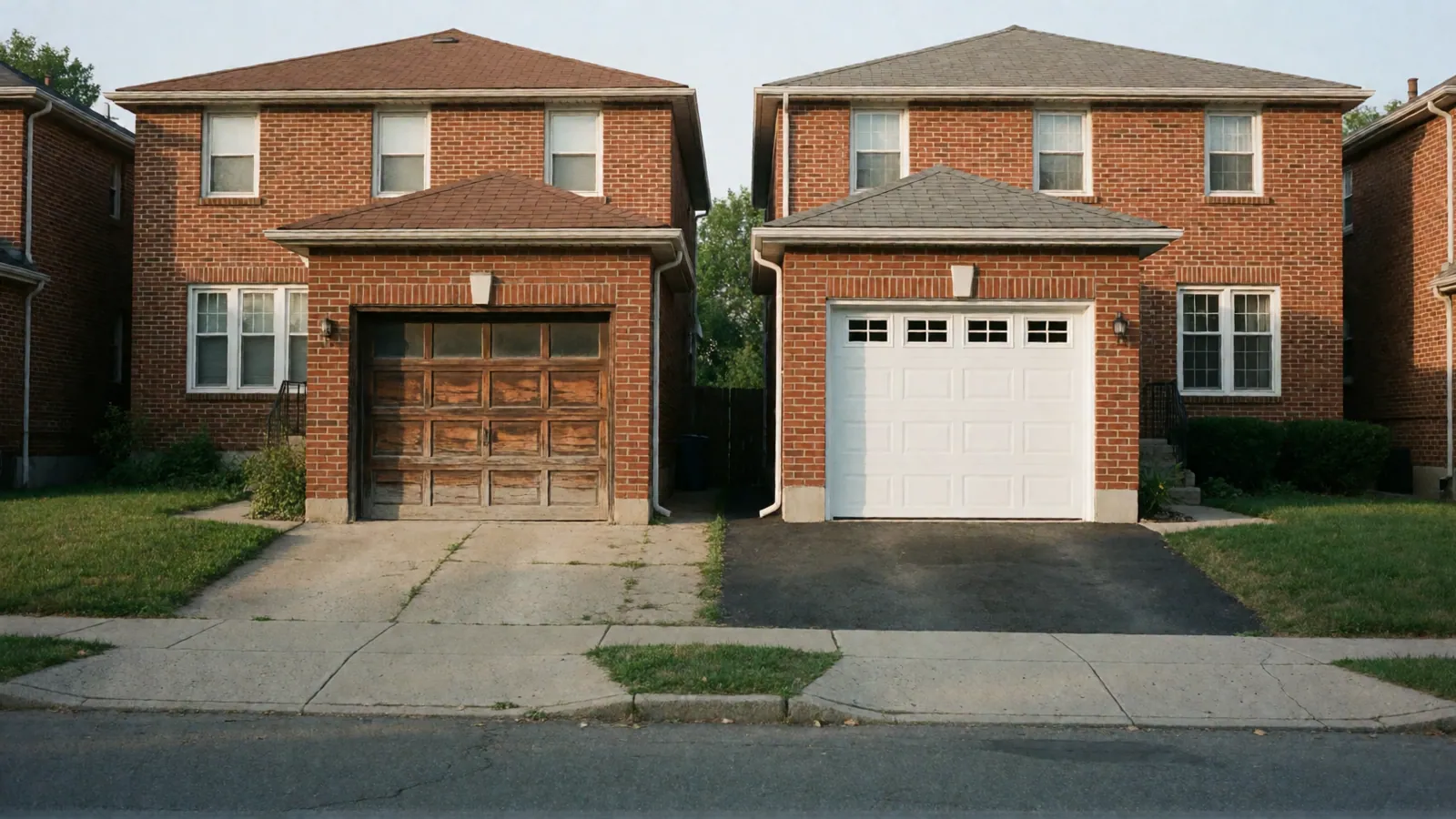
AI-generated illustration. Not a real home or business.
Start with the opening
The symptom check asks "How wide is the door?" and answers it in plain words: "one car wide, about eight to ten feet", or "two cars wide, about sixteen to eighteen feet". The width is what the published price follows. It is not what decides whether a door fits.
What decides that is the room around the opening: the headroom above it, where the tracks curve back and the springs sit; the room at each side for the tracks; the depth back to the far wall, for the door to lie flat when it is open; and the frame the tracks and the door are fixed to. Garages under Queens houses were built to every measurement there is, which is why nothing is ordered from a form:
A new door is measured first: the opening, the headroom above it, the room at the sides and back to the wall, and the frame it fixes to. The measuring visit costs nothing, and you don't have to sign anything after it.
Priyanka Halvorsen-Mbeki measures openings for new doors and orders them. She measures the headroom twice, because a door that does not fit the space above it does not fit. She orders a door only after the three days to cancel are over.
Insulated steel, with windows or without
The doors this company puts in are insulated steel sectional doors: sections of steel with a layer of insulation inside, riding on rollers in two tracks. In a garage under a house, sharing a wall or a floor with the rooms, the insulation is what an owner notices: the door is quieter as it moves, stiffer when the weather leans on it, and the garage stays nearer the warmth of the house in winter.
Windows are the other choice, a row of small ones across the top section. They let daylight into a garage that has none, and they let anybody on the sidewalk see whether the car is in. Plenty of owners choose them for the first reason and plenty leave them out for the second, and it is decided at the measuring visit, with the garage in front of you. Either way the door is priced inside the same published range.
An opener with it, or not
A new door can go in with a new opener or without one. If it has one, the symptom check asks "Where would the opener go?", and there are two answers: "on the ceiling, with a rail to the door", or "on the wall beside the door, with no rail". The ceiling opener is the familiar one. The wall opener sits beside the door and needs no rail across the ceiling, which suits a garage with little headroom, or a ceiling the owner would rather keep for storage. Either way it needs power where it hangs:
A new opener plugs into an outlet near where it is mounted, on the ceiling for a rail opener or on the wall beside the door for a wall one, never into an extension cord. If there isn't one, a licensed electrician adds it before the opener goes up: that is electrical work, with its own permit, and this company does not do it.
The rules that come with a new door
Two of the city's rules come with every new door, and the contract carries both:
Replacing a garage door in the same opening needs no Buildings permit. Widening an opening or building a garage does, and that is not something this company takes on. Every New York City contract comes with a signed notice saying whether any permit is needed.
New York City's Building Code requires a garage door to be tested for the wind it will face; a new door's maker states its rating, and the contract names the door by make and model.
What it comes to
This is the symptom check's answer for a two-car door with a ceiling opener under a detached house, at the published prices. There is no check-first list and no answer about using the door, because an installation is not a repair: the old door is going.
A worked example: a symptom check
A new two-car door with an opener A two-car door under a detached house in Bayside
The eight answers behind it
- What do you need?
- A new garage door
- Where is the house?
- Elsewhere in Queens
- Do you own the house?
- Yes, I own it, alone or with someone
- What kind of house is it?
- A detached house, one home
- How wide is the door?
- Two cars wide, about sixteen to eighteen feet
- With a new opener as well?
- Yes, with a new opener
- Where would the opener go?
- On the ceiling, with a rail to the door
- Is there an electrical outlet where the opener would go?
- Yes, there is an outlet there
Price range at our published prices
- A new insulated steel sectional door, installed, the old one taken away$2,350 to $2,750
- A new ceiling opener with a belt rail, installed$625
- The price range, before tax$2,975.00 to $3,375.00
- No sales tax on a new door or opener installed, with New York's capital improvement certificate.
- The price range, with tax$2,975.00 to $3,375.00
The published price, measured first. A written contract is signed before anything is ordered, and nothing is ordered until the three business days to cancel are over.
The symptom check's answer to these questions, at the published prices. Nobody has seen your door.
The card carries no sales tax line, and New York's tax rules give the reason:
Sales tax is worked out line by line. A repair to a house is taxable in New York City, and 8.875% is added to it on its own line. A complete new door or a complete new opener installed is a capital improvement: no sales tax is charged on that line when you sign New York's capital improvement certificate, Form ST-124, which you sign and give to the company with the contract.
The day itself
A new door is made to its size and usually arrives two to four weeks after the contract is signed and the three days are over. It is installed in a day, the old door and its springs taken away the same day.
The front of the garage has to be clear, and the day goes better with a few things arranged beforehand:
Empty the garage's front few feet and the wall above the door.
Leave room on the driveway or the curb for the new door's sections.
Have an outlet near where the opener will hang, or ask a licensed electrician to add one before the day.
Plan to be without the garage for most of the day.
Keep pets and children away while the old door comes down.
Check your door
Try the symptom check: what would be looked at first, whether to stop using the door, and the published prices, in about two minutes. Sending it to us books nothing.