The journal
An opener from before 1993: why it is replaced, not repaired
What the federal opener rule requires, how to tell whether an opener predates it, and why a door without working sensors is not made to close by turning it up.
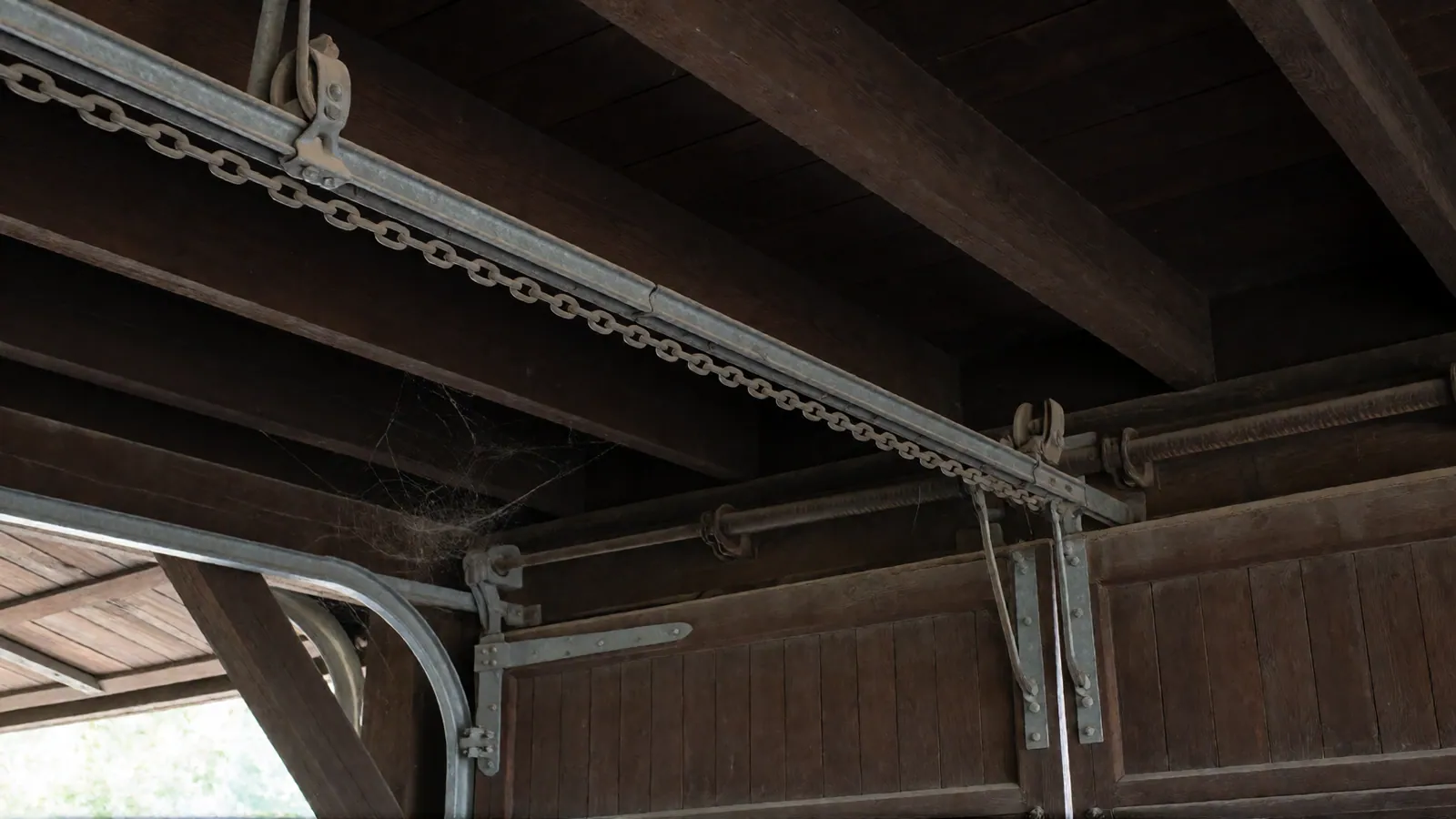
AI-generated illustration. Not a real home or business.
A question with no answer from a distance
Owners ask it often, usually about an opener that came with the house. It has no honest answer from a distance. Nobody who has not seen an opener can call it fit to use, and this site never tries; what it can say is what the law asks of an opener, how to tell whether yours was built to it, and what happens when it was not. The symptom check keeps to the same line:
The check never tells you a door is safe. It has not seen it. It can only tell you when to stop using it, and it does that for every symptom a broken spring or a snapped cable can cause.
What the federal rule asks
The rule is federal, and it is about how an opener is built:
- 16 CFR part 1211 (opens the source in a new tab) Automatic residential garage door operators made for sale in the United States must reverse a closing door within two seconds of meeting an obstruction, with a further means of protection such as photoelectric sensors.
Two protections, then: a reverse when the door meets something, and a further means of protection, such as the pair of sensors by the floor, that stops the door before it does. An opener built before the rule may reverse on contact, but it was never built with the second protection, and a reverse that has gone untested for decades may no longer do what it once did:
An opener made before 1993 was not built with the second means of protection the federal rule now requires, such as the sensors near the floor, and many no longer reverse. In New York an opener that doesn't reverse may be serviced only if the service makes it reverse, and one without a sensor could not be installed today. It is priced here for replacing.
How to tell
The plainest sign is at the bottom of the door. The symptom check asks "Are there two small safety sensors near the floor, one on each side of the door?", and adds: "They usually have a small light on them, and they face each other across the opening." An opener with no sensors at all is either older than the rule or has had them taken off, and either way it is priced for replacing, for the reason in the worked example below.
The age is the other sign, and the check asks for it too, "Roughly when was the opener put in?", with a line that matters as much as the question: "A guess is fine. An opener's age is often on a sticker on its motor unit; don't climb up to read it." Not knowing is a good enough answer, and the check says what happens then:
You weren't sure how old the opener is. The technician looks for its date first; one from before 1993 would be priced for replacing.
A worked example
This is the symptom check's answer for an opener with no sensors on a one-car door that shudders as it moves. The door is not stopped, because nothing it describes points at a spring or a cable, but the price range carries a new opener, and the last line of the card says why:
A worked example: a symptom check
An old opener that won't stop shuddering A one-car door under a detached house in Middle Village
The twelve answers behind it
- What do you need?
- Something is wrong with the garage door at my house
- Where is the house?
- Woodside or a neighborhood next to it
- Do you own the house?
- Yes, I own it, alone or with someone
- What kind of house is it?
- A detached house, one home
- What kind of garage door is it?
- Sections that roll up overhead on two tracks
- How wide is the door?
- One car wide, about eight to ten feet
- Where are its springs?
- On a bar across the wall just above the door
- Does it have an opener?
- Yes, it opens with a button or a remote
- Are there two small safety sensors near the floor, one on each side of the door?
- No, there are none
- Roughly when was the opener put in?
- 1993 or later
- What is the door doing?
- It grinds, squeals or shudders as it moves
- From the floor, without touching anything: is there a gap in the coil of a spring?
- No, the coil looks whole
Use the door?
Use it with care until the visit
Nothing you've told us is on the list of symptoms that stop a door. Until the visit, watch the door all the way every time it moves and keep out from under it while it does, and stop using it if it gets worse or you hear a bang. Test once a month that it reverses, as your opener's manual says, but never on a door whose spring or cable might be broken.
Check-first list
What a technician looks at for what you describe, in the order they look. It names no fault: nobody has seen the door.
- The rollers and hinges Worn bearings, cracked wheels, bent stems and loose hinge bolts, section by section.
- The tracks Whether both are straight, upright and bolted tight, and the rollers sit in them all the way up.
- The springs Whether either is broken, and whether the door is balanced once the opener is disconnected by the technician.
- The opener's drive The motor's gear, the belt or chain, the carriage on the rail and the arm to the door.
- The opener's reversing test, as New York requires Run by anyone who works on a garage door, its springs or its tracks. If the opener fails it, a DANGER label goes on the opener and you get written notice within ten days.
What you can check yourself first
Nothing: leave it for the technician.
Price range at our published prices
- The first visit costs nothing, and you don't have to sign anything after it.
- Adjusting and lubricating, nothing replaced$75
- Every roller replaced$165
- Bent or cracked hinges replaced$95 to $165
- A new ceiling opener with a belt rail, installedNo sales tax on a new door or opener installed, with New York's capital improvement certificate.$625
- The price range, before tax$75.00 to $1,030.00
- Sales tax, 8.875%$6.66 to $35.94
- The price range, with tax$81.66 to $1,065.94
From the least it could need to everything listed. A written price is given at the first visit, and the repair is done after the three business days to cancel.
- New York has required openers installed on homes to have a safety sensor since 1993, and anyone who services an opener without one must warn the owner in writing within ten days. Here that is a replacement price, not a repair.
The symptom check's answer to these questions, at the published prices. Nobody has seen your door.
Why it is not made to close another way
There is a shortcut some sites offer instead of a new opener: more force, so that the door pushes through whatever stops it, or sensors that no longer see their beam. Neither is offered here, and the reason is the same law the rest of this piece describes:
Since 1993, every home garage door opener made for sale in the U.S. has had to reverse within two seconds when it touches something, and to work with a safety device such as the two small sensors near the floor, which it checks every time it closes. That is why an opener refuses to close when a sensor is blocked or out of line, and why we never bypass, bridge or remove the sensors, or turn the force up to make a door close.
What New York adds
New York's own law on garage door openers binds anyone who works on a garage door, its springs or its tracks: they test on site that the opener reverses, and if it fails they fix the law's DANGER label to it and give the owner written notice within ten days. Nobody may install an opener on a home without an automatic reverse and a safety sensor.
- N.Y. General Business Law § 391-k(2)(b) (opens the source in a new tab) No one may service or repair a garage door opener that does not reverse unless the service brings it into compliance, and anyone servicing the door, its springs or tracks tests the opener on site, labels one that fails, and gives the owner written notice within ten days.
- N.Y. General Business Law § 391-k(3) (opens the source in a new tab) Since January 1, 1993 no one may install an opener on a residential building without an edge sensor, an optical sensor or a similar entrapment protection device, and anyone who services one without such a device warns the owner in writing within ten days.
Leocadia Brandt-Osei repairs and fits openers, sensors and remotes. She runs the reversing test on every opener before she leaves.
Check your door
Try the symptom check: what would be looked at first, whether to stop using the door, and the published prices, in about two minutes. Sending it to us books nothing.