The journal
The garage door checks an owner can do, and where they stop
The monthly reversing test, clean sensor lenses, a clear track and a fresh remote battery, and the line an owner never crosses: the springs and the cables.
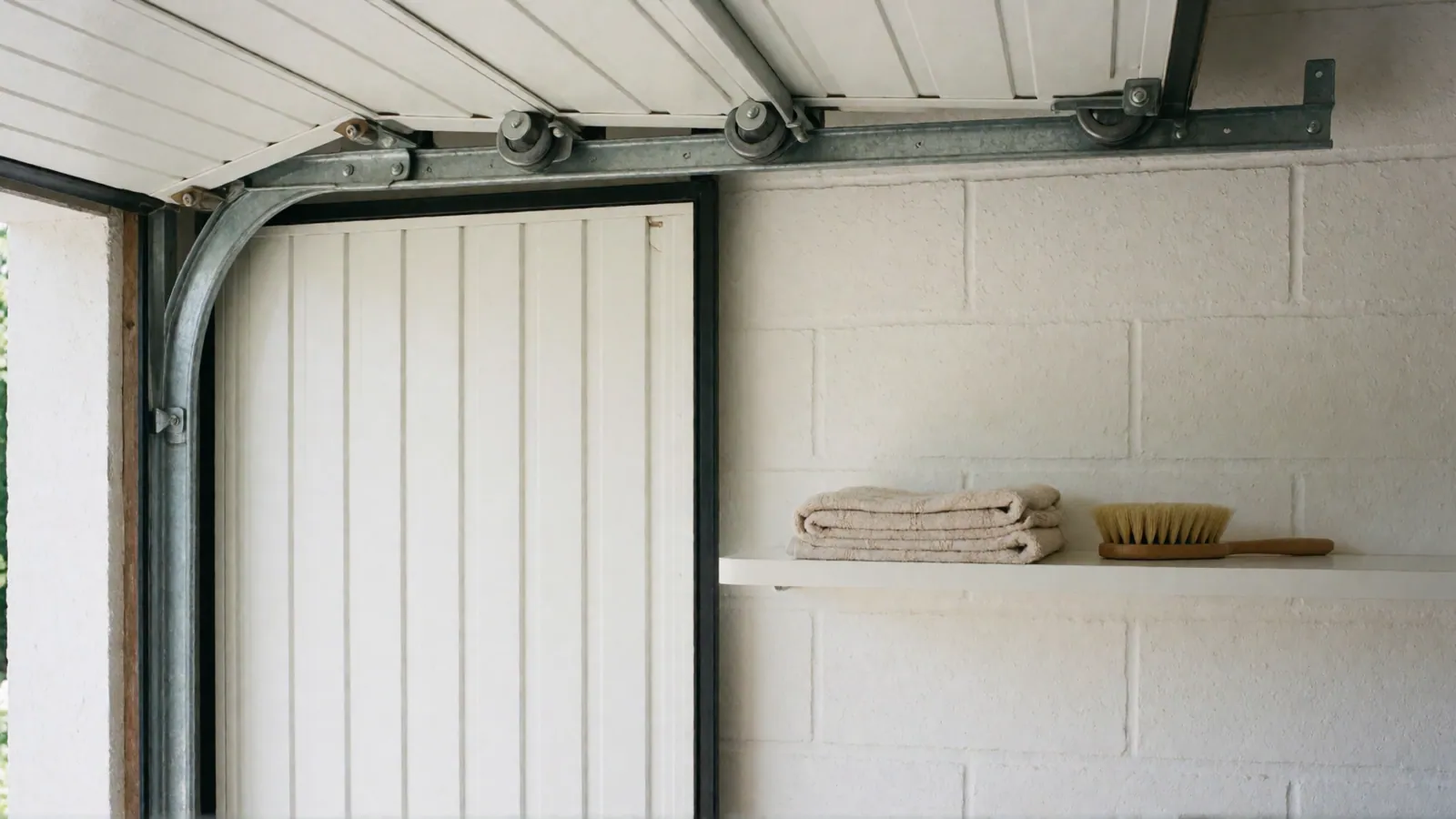
AI-generated illustration. Not a real home or business.
Once a month
An owner's part in looking after a garage door is small, and most of it takes less time than reading about it. The one regular check is the one the opener's own manual asks for:
Once a month, the opener's manual asks you to watch the door close all the way and to test that it reverses when it meets something on the floor, such as a roll of paper towels laid flat, but never on a door whose spring or cable might be broken. Keep the sensors' lenses clean and the track clear of anything stored beside it. Everything else, from the springs and cables to the opener's force setting, is a technician's at a tune-up.
The test has one exception, and it matters more than the test:
Test once a month that it reverses, as your opener's manual says, but never on a door whose spring or cable might be broken.
When the door misbehaves
Some symptoms come from something an owner can check first without going near a spring or a cable, and the opener's own manual asks you to: a sensor lens with dust on it, a box in the sensors' beam, an opener unplugged, a wall control's lock switched on, a remote's flat battery. The check lists those where they apply, and none for a door it has told you to stop using.
These are all of them. Each belongs to a symptom: the lenses and the beam to a door that closes and goes back up, the wall button to one whose light flashes, the plug, the breaker and the lock switch to an opener that does nothing at all, and the battery to a remote that has stopped while the wall button still works:
- Wipe the two sensors' lenses with a soft dry cloth.
- Move anything standing between the two sensors, even a leaf or a box on the floor between them.
- If the light still flashes, leave the door closed or open as it is and wait for the visit; don't hold the wall button down to force it.
- Check that the opener is plugged in and that the breaker for the garage has not tripped.
- Check that the wall control's lock or vacation switch is off.
- Put a new battery in the remote.
If one of them puts it right, that is the end of it. If none does, the door is left as it is and the next step is a visit.
What to notice
The rest of an owner's part is noticing. A door that has started to grind or squeal, or a line of daylight under its bottom edge where there was none, is one the symptom check leaves in use with care, and both are worth mentioning when the office calls. A bang, or a door that suddenly feels heavy, is different. The list an owner is left with after any work on the door says what to do then, and what to keep doing:
Watch the door close all the way the first few times.
Keep the sensors' lenses clean and nothing stored in their beam.
Once a month, test that the door reverses when it meets something laid flat on the floor, but never if a spring or a cable might be broken.
If you hear a bang or the door feels heavy, stop using it and call.
Leave the springs, the cables and the bottom brackets to a technician, always.
The line an owner never crosses
Everything above is on one side of a line, and the springs and the cables are on the other. The reason is the same one this site gives on every page that mentions them:
A garage door's springs hold the door's weight, and a wound torsion spring holds it under great force. Releasing that force without the right tools and training is how people are badly hurt. That is why the springs, the cables and the brackets at the bottom corners are a technician's work and nobody else's, and why nothing on this site tells anybody how to adjust, unwind or replace them.
The force setting on the opener belongs on that side too, and so does the release cord on any door that might have a broken spring. None of it looks dangerous, which is the trouble: a wound spring sitting still on its bar gives no sign of the force in it. This company gives no instructions for any of it:
- Not offered: instructions for adjusting, unwinding or replacing a spring or a cable.
A tune-up, for the rest
What an owner leaves alone is what a tune-up is for, on a door that already works:
Every moving part looked at, the balance tested, the hinges and rollers lubricated, and the opener's reversing test run, at a published price.
| The prices | One-car door | Two-car door |
|---|---|---|
| A repair to a house is taxable in New York City, and 8.875% is added to it on its own line. | ||
| A tune-up and safety check | $145 | $165 |
Imogen Adeyemi-Kowal runs the company and does many of the repair visits herself. She tests the balance of every door before she says what it needs.
Check your door
Try the symptom check: what would be looked at first, whether to stop using the door, and the published prices, in about two minutes. Sending it to us books nothing.