About
The parts of a garage door, described by what they do
Springs, cables, tracks, rollers, sections, seals and the opener, in plain words and with no maker's name, and what a technician looks for in each.
AI-generated illustration. Not a real home or business.
The springs, which hold the door up
The opener does not lift a garage door. The springs carry its weight, and the opener, or a hand, only moves it.
Torsion springs
On a bar across the wall just above the door. They twist as the door comes down and give that force back as it goes up, through a drum at each end of the bar and a cable from each drum to the bottom of the door.
Extension springs
Stretched along each side, above the tracks. They stretch as the door comes down and pull it up as they shorten. Each one should have a cable running through it, which is why new extension springs are priced with their safety cables.
A balanced door is one the springs hold at whatever height it is left, so that it neither drifts down nor rises on its own. That is what the technician tests with the opener disconnected, and it is the first thing a broken or tired spring takes away.
Two springs on a door age together, so when one breaks the other is near its end too. Replacing both keeps the door balanced and spares you a second visit for the second spring.
The springs
Whether either is broken, and whether the door is balanced once the opener is disconnected by the technician.
A garage door's springs hold the door's weight, and a wound torsion spring holds it under great force. Releasing that force without the right tools and training is how people are badly hurt. That is why the springs, the cables and the brackets at the bottom corners are a technician's work and nobody else's, and why nothing on this site tells anybody how to adjust, unwind or replace them.
The cables, the drums and the bottom brackets
On a torsion door the springs reach the door only through the two lift cables. Each is wound on a drum at the end of the bar and fixed to a bracket at a bottom corner of the door, and both the cable and the bracket hold the springs' force.
That is why a snapped cable stops a door as surely as a broken spring, and why a door with one cable gone hangs lower on one side. The cables are replaced as a pair for the same reason the springs are.
The lift cables and drums
Both cables, from the drum at the top to the bracket at the bottom corner, for fraying, slack and how they sit in the grooves.
The tracks, the rollers and the hinges
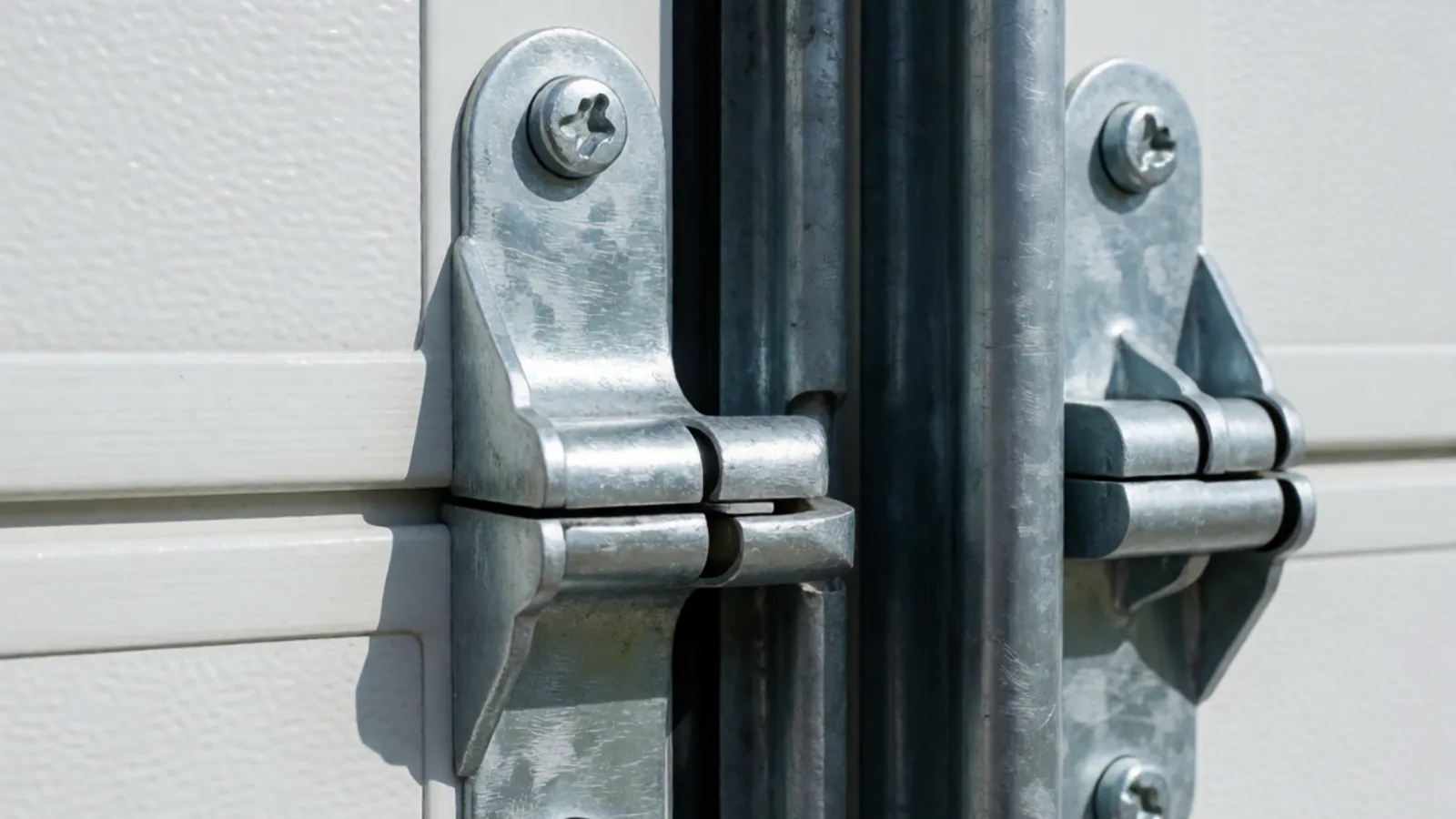
A sectional door rides up on two tracks, one on each side, that run up beside the opening and curve back under the ceiling. A roller at the edge of each section runs in the track, and hinges across the seams let the sections fold over the curve.
A bent track, a roller with a worn bearing or a cracked hinge shows up first as noise or a door that catches at one spot. Left alone, it can bind the door, and a door that binds can come out of its track.
The tracks
Whether both are straight, upright and bolted tight, and the rollers sit in them all the way up.
The rollers and hinges
Worn bearings, cracked wheels, bent stems and loose hinge bolts, section by section.
The sections and the seals
The door itself is a stack of horizontal sections, usually steel, often with insulation inside. A section bent by a bumper can stop the door folding over the curve of the track, so a dent is looked at for how the door moves as well as how it looks.
A single section can be replaced only where the maker still makes one to match the rest; where it does not, the answer is usually a new door. Along the bottom, a rubber seal closes the gap to the floor, and weatherstrip does the same at the sides and the top.
The sections
Bends, cracks and the joints between them, and whether the door binds where a section is bent.
The seals
The rubber seal along the bottom, the weatherstrip at the sides and top, and whether the door closes flat on the floor.
The opener
Two kinds are fitted here, and either one moves a door that the springs already balance.
A ceiling opener with a belt rail
On the ceiling, with a rail to the door. The motor hangs from the ceiling and a carriage runs along the rail, pulling the door by an arm fixed to its top section.
A wall-mounted opener
On the wall beside the door, with no rail. It sits beside the door rather than over it, which leaves the ceiling clear where there is little room above the door.
Ceiling openers with a belt rail or wall-mounted openers beside the door, and insulated steel sectional doors, chosen at the measuring visit for the garage. No maker is named on this site; the contract names the make and model of each.
An opener is not built to lift a door whose springs have given out. Working against a heavy door wears it out early, and a door that is not balanced is harder for the opener to stop and send back up.
The opener's settings
Its travel limits and its force setting, and the reversing test on something placed under the door.
The opener's drive
The motor's gear, the belt or chain, the carriage on the rail and the arm to the door.
The power
The outlet the opener plugs into, the breaker, and the wall control's lock switch.
The opener's release cord disconnects the door from the opener. On a door with a broken spring it takes away the only thing holding the door up, so it is never pulled on a door that may have one.
The sensors
Two small boxes near the floor, one on each side of the opening, facing each other.
Since 1993, every home garage door opener made for sale in the U.S. has had to reverse within two seconds when it touches something, and to work with a safety device such as the two small sensors near the floor, which it checks every time it closes. That is why an opener refuses to close when a sensor is blocked or out of line, and why we never bypass, bridge or remove the sensors, or turn the force up to make a door close.
The safety sensors
Whether the two are lined up, clean and wired, and the reversing test with the opener.
The opener's reversing test, as New York requires
Run by anyone who works on a garage door, its springs or its tracks. If the opener fails it, a DANGER label goes on the opener and you get written notice within ten days.
The remotes, the keypad and the wall control
The wall control is wired to the opener. The remotes and an outside keypad talk to it by radio, and each one has to be programmed to it, which is why a new remote is priced programmed. Nobody here needs to know a keypad's code to do that.
Two of the owner's own checks belong here, and both are in the opener's manual:
- Put a new battery in the remote.
- Check that the wall control's lock or vacation switch is off.
The remotes and the keypad
Their batteries, and whether each is still programmed to the opener.
What each part costs to replace
The published price of each job, for a one-car door and a two-car door, with the sales tax on its own line.
| The prices | One-car door | Two-car door |
|---|---|---|
| A repair to a house is taxable in New York City, and 8.875% is added to it on its own line. | ||
| Both torsion springs replaced | $290 to $360 | $360 to $420 |
| Both extension springs replaced, with their safety cables | $195 to $235 | $235 to $275 |
| Both lift cables replaced | $175 | $175 to $195 |
| The door set back on its tracks, a bent track replaced if it has to be | $225 to $365 | $225 to $365 |
| Every roller replaced | $165 | $195 |
| Bent or cracked hinges replaced | $95 to $165 | $95 to $195 |
| One damaged section replaced, where a match can be had | $475 | $650 |
| A new bottom seal | $145 | $175 |
| A new pair of safety sensors | $160 | $160 |
| The opener's gear, drive or control board repaired | $135 to $265 | $135 to $265 |
| A new remote, programmed | $55 | $55 |
No maker's name, and whose promise covers a part
This company is no maker's dealer, installer or partner, and holds no industry certification of any kind. The doors and openers are described here by what they are, and the contract names the make and model.
We promise what is in writing: the work, the parts, the price and the dates. We don't offer a warranty of our own, a lifetime anything or a guarantee of satisfaction. Springs, openers and doors carry their makers' warranties, whose terms the makers write.
A real contractor's paperwork should keep two promises apart: the maker's warranty on a part, written by the maker, and the contractor's own promise about its work. In New York City a contractor who advertises a guarantee must put its terms in the ad and in the contract, and may not offer a lifetime one; a spring sold as "lifetime" is a promise about the part, from its maker, if anyone.
Check your door
Try the symptom check: what would be looked at first, whether to stop using the door, and the published prices, in about two minutes. Sending it to us books nothing.