What we will not claim
A wound spring holds the whole door. Nobody but a technician touches it.
Why this site gives no steps for a spring, a cable or a bottom bracket, and what it tells an owner to do instead.
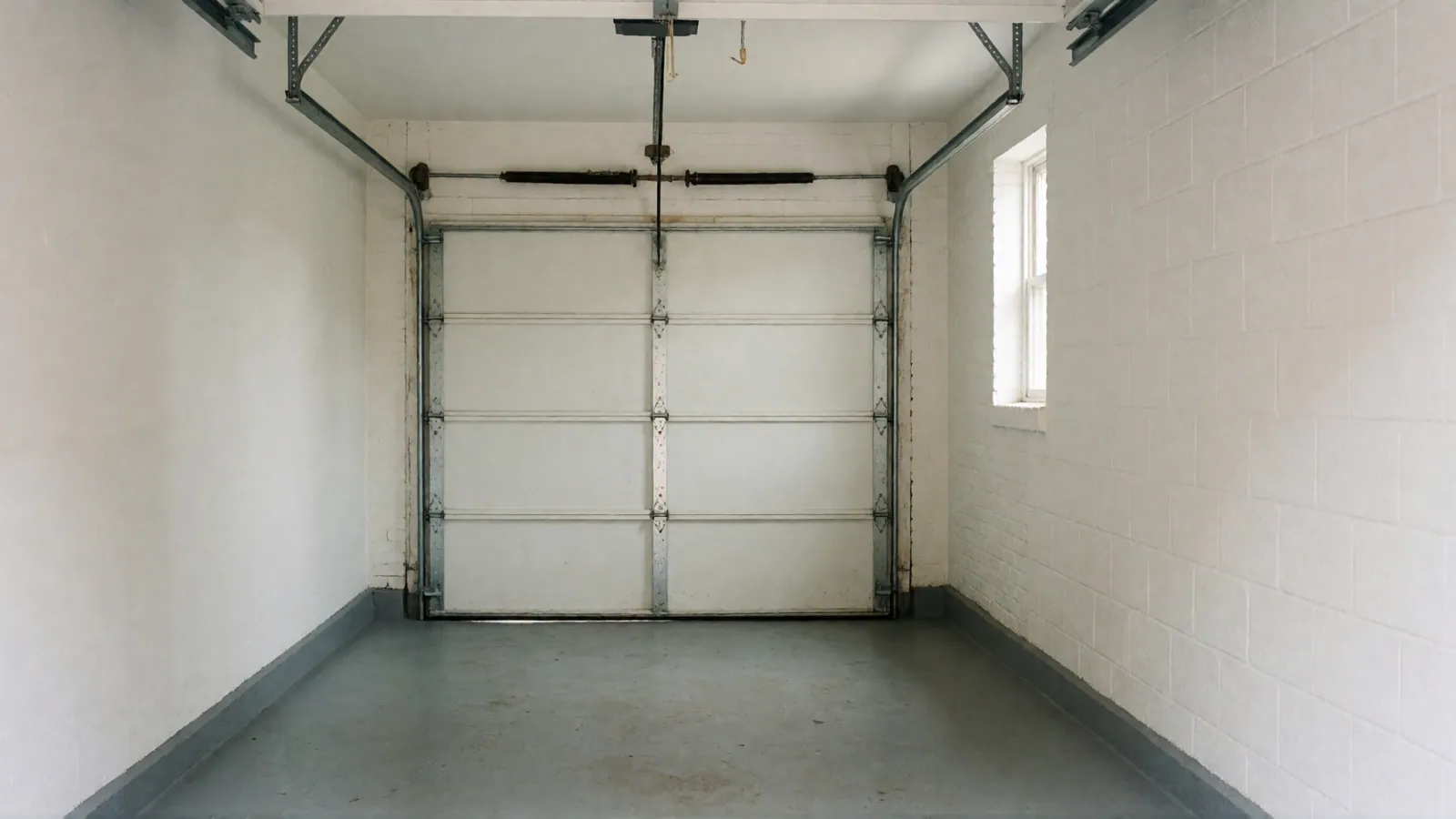
AI-generated illustration. Not a real home or business.
What you will see advertised
“Broken spring? Watch our video and replace it yourself in twenty minutes with a kit.”
Quoted in order to be refused: this company never says it, and the rest of this page says why.
Every opener's instructions tell its user that weak or broken springs may let the door fall, to use the release only with the door closed, and to have a qualified service person repair the cables and spring assemblies; the federal safety agency says an unbalanced door can crash to the floor. So this site gives no steps for a spring, a cable or a bracket, and its symptom check tells you to stop using the door instead.
What the rules say
Each read against its source in October 2026.
- Every opener's instructions tell its user to use the emergency release only when the door is closed if possible, that weak or broken springs may let the door fall, and to have a qualified service person repair cables, spring assemblies and other hardware (16 CFR 1211.16).
- A severely unbalanced garage door could crash to the floor, and a door that is not balanced, or binds or sticks, should be serviced by a professional (CPSC Pub 523).
The sources, to read in full:
What we say instead
Stop using the door until it has been looked at. Don't run the opener, don't try to lift the door by hand, and don't pull the opener's red release cord: with a weak or broken spring the door can drop fast. Don't touch the spring, the cables or the brackets at the bottom corners of the door. Keep people, pets and cars out from under it.
A garage door's springs hold the door's weight, and a wound torsion spring holds it under great force. Releasing that force without the right tools and training is how people are badly hurt. That is why the springs, the cables and the brackets at the bottom corners are a technician's work and nobody else's, and why nothing on this site tells anybody how to adjust, unwind or replace them.
The opener's release cord disconnects the door from the opener. On a door with a broken spring it takes away the only thing holding the door up, so it is never pulled on a door that may have one.
- We do not tell anybody how to adjust, unwind or replace a spring or a cable.
Why garage door sites say it, and why it doesn't hold
A spring gives way with a bang, often on an evening or a weekend, and a door that will not lift shuts the car inside the garage. Clips of a stranger's hands working on a spring promise a way out of the wait and the bill, and a site that links to one looks generous with what it knows.
The rules above say what every opener's own instructions say: weak or broken springs may let the door fall, and the cables and spring assemblies are for a qualified service person. A wound spring holds the door's weight under great force, and the work that goes wrong is the work that lets that force go at the wrong moment, with a hand or a face in its path. The parts and the price are the small part of the job. What a clip cannot show is the moment it goes wrong, and on a spring that moment does not give anybody a second try.
What a garage door company can honestly say, and do
What a site can honestly do is say what a technician looks at, in the order they look, and leave every step after that to the technician. For a spring and its cables, that is:
The springs
Whether either is broken, and whether the door is balanced once the opener is disconnected by the technician.
The lift cables and drums
Both cables, from the drum at the top to the bracket at the bottom corner, for fraying, slack and how they sit in the grooves.
And what an owner can usefully do is look from the floor, tell the office what they saw, and leave the door where it is. That is the whole of it, and this company offers nothing beyond it:
A torsion spring that has broken usually shows a gap of a few inches in its coil. You can look for one from the floor; never climb up to it or touch it.
- Not offered: instructions for adjusting, unwinding or replacing a spring or a cable.
What to ask any garage door company
Ask them of anybody who comes to look at your door, this company included. A plain answer tells you something, and so does a vague one.
- Will you replace both springs, and if not, why not?
- Will you test the door's balance before you leave, with me watching?
- Are the cables and the bottom brackets looked at as part of the visit?
- What should the rest of the household be told about the door until you come?
- Is the price for the pair of springs written down before you start?
Check your door
Try the symptom check: what would be looked at first, whether to stop using the door, and the published prices, in about two minutes. Sending it to us books nothing.