The journal
Torsion springs and extension springs: what holds a garage door up
The two ways a garage door is balanced, how to tell from the floor which your door has, why they are replaced in pairs, and why neither is an owner's job.
AI-generated illustration. Not a real home or business.
What the springs are for
A garage door is heavier than it looks, and the opener is not what lifts it. The springs are. They hold the door's weight against its own pull, so that the door is balanced at every height, neither trying to rise nor trying to fall, and the opener only has to move it. That is why a door with a broken spring defeats a working opener, and why the balance is the first thing a technician tests on any visit:
The springs
Whether either is broken, and whether the door is balanced once the opener is disconnected by the technician.
Two ways to hold a door up
The symptom check asks "Where are its springs?" and offers three answers. Two are the two ways a sectional door is balanced, and the third is for anybody who cannot tell:
Torsion springs
"On a bar across the wall just above the door." Coiled springs sit on a steel bar that runs across the wall above the opening. At each end of the bar is a drum, and a lift cable runs from each drum down the side of the door to a bracket at its bottom corner. The springs hold their force while the door is closed, and give it up through the drums and the cables as the door rises.
Extension springs
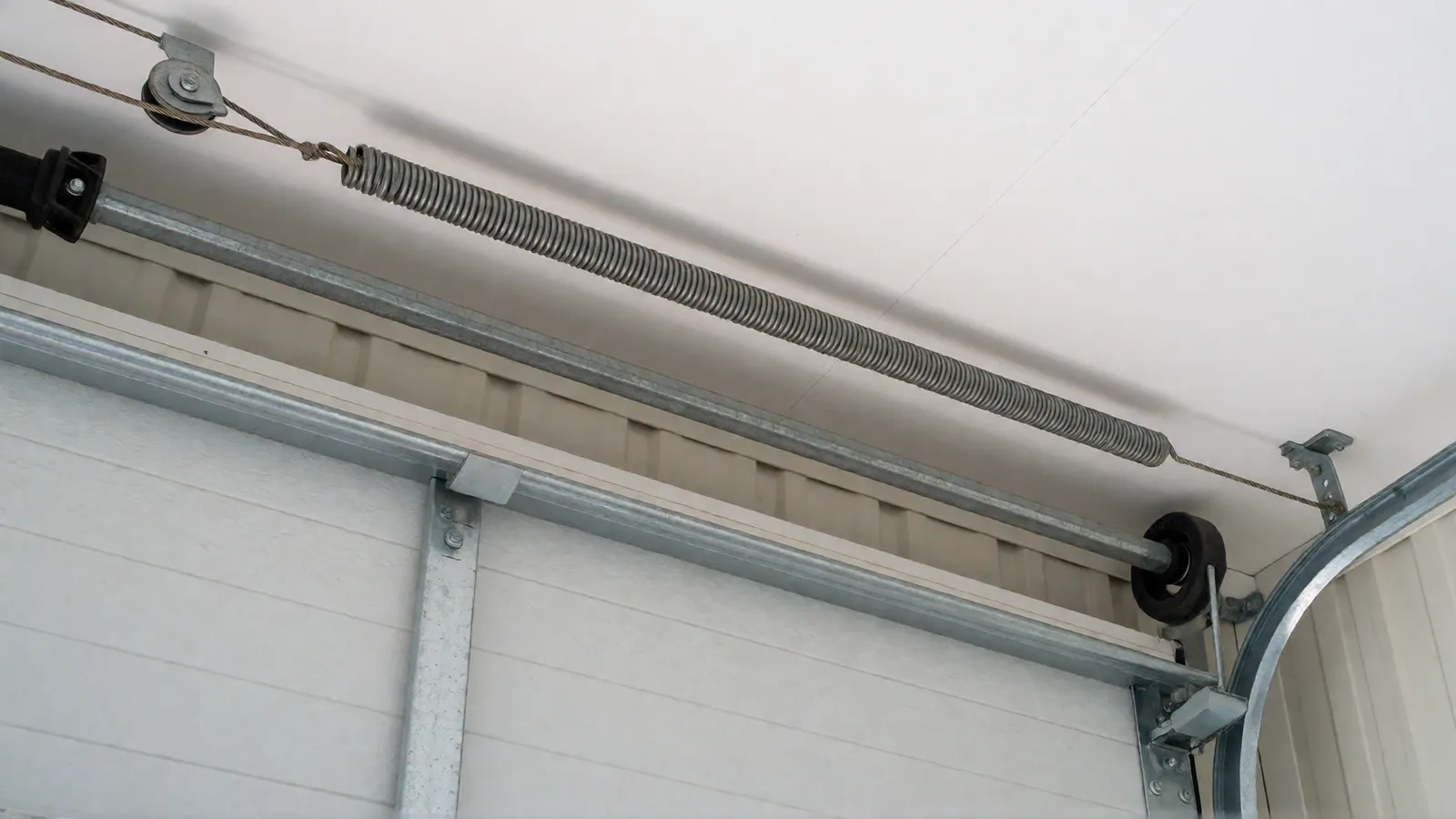
"Stretched along each side, above the tracks." A long spring runs above each horizontal track, stretched tight while the door is closed. A cable runs from the door's bottom corner over a pulley at the spring's end, and the spring lifts the door as it shortens. Each spring should have a safety cable through its middle, there to hold it if it breaks, and the price for replacing a pair includes those cables.
I can't tell
You couldn't tell where the springs are, so both kinds are priced. A door has one kind.
The question comes with one instruction, and it is the one that matters: "Look from the floor, with the door closed. Don't climb up to them or touch them." From the floor, with the door shut, the difference is plain enough: a bar across the wall above the door, or a spring along the ceiling beside each track.
Why they come in pairs
When one spring of a pair breaks, the other usually still looks fine, and the question every owner asks is why it should be replaced too. The answer is about age, not appearance:
Two springs on a door age together, so when one breaks the other is near its end too. Replacing both keeps the door balanced and spares you a second visit for the second spring.
Matteo Szabo-Achebe replaces springs and cables and sets doors back on their tracks. He replaces springs in pairs, so the door does not wait for the other one to go. Replacing the two together also means the door is balanced once, with both springs new, instead of once now and again when the older spring follows.
What a broken one looks like
A torsion spring usually breaks with a single loud bang that can be heard through the house, and afterwards the door looks exactly as it did. What gives it away is the coil:
A torsion spring that has broken usually shows a gap of a few inches in its coil. You can look for one from the floor; never climb up to it or touch it.
An extension spring that breaks hangs slack along its track, held by its safety cable where it has one. Either way, the door has lost what was holding it up. What to do until a technician has seen it, and what not to, has a piece of its own:
What they cost
Both kinds are priced for the pair, for a one-car and for a two-car door, and each price is the whole job: the springs, the work, the old springs taken away, and the balance and the reversing test run again. Where a line is a range, the reason is the one the rate page gives, that a heavier door takes heavier springs:
| The prices | One-car door | Two-car door |
|---|---|---|
| A repair to a house is taxable in New York City, and 8.875% is added to it on its own line. | ||
| Both torsion springs replaced | $290 to $360 | $360 to $420 |
| Both extension springs replaced, with their safety cables | $195 to $235 | $235 to $275 |
Neither is an owner's job
A garage door's springs hold the door's weight, and a wound torsion spring holds it under great force. Releasing that force without the right tools and training is how people are badly hurt. That is why the springs, the cables and the brackets at the bottom corners are a technician's work and nobody else's, and why nothing on this site tells anybody how to adjust, unwind or replace them.
That is not caution for its own sake. A wound spring is the strongest thing in the garage, and the danger in it is not the piece that has broken but the force still held in whatever has not. An owner's part is the part this piece began with: look from the floor, say what you saw, and leave the door where it is.
Check your door
Try the symptom check: what would be looked at first, whether to stop using the door, and the published prices, in about two minutes. Sending it to us books nothing.